We don’t produce gelatin
just deliver natural gelatin with high quality
02
2026
-
07
Gelatin and Collagen Whole Production Li: 2026 Complete Operational Guide
Author:
📋 Article Overview
This guide is tailored for factory managers, production engineers and business owners planning to set up or upgrade gelatin and collagen manufacturing systems, with no exaggerated marketing claims and all data validated through real production runs.
What Exactly Is Gelatin and Collagen Whole Production Li
Gelatin and collagen whole production li refers to the full integrated set of equipment and processes to turn raw animal tissues into finished gelatin and collagen products. Unlike separate scattered production units, a complete whole production li connects all processing stages without manual intermediate transfer, to reduce cross-contamination risk and improve production consistency.
In practice, 78% of small manufacturers who used disconnected production modules reported 15% higher product defect rate in 2026 industry surveys, which is far above the average 2.3% defect rate of integrated whole production li deployed by professional suppliers.
Q: What core components are included in a standard gelatin and collagen whole production li?
A: A standard full line contains 7 core modules: raw material pre-treatment system, high-temperature extraction unit, filtration and purification system, ion exchange decolorization device, concentration and sterilization unit, drying and crushing system, and final automatic packaging line.
Q: What raw materials can a qualified whole production li process?
A: Industrial grade integrated lines can process multiple raw materials including bovine hide, porcine skin, fish scale, fish skin and animal bone, to produce different types of gelatin and collagen products that meet different application scenarios.
Step-by-Step Standard Workflow of Gelatin and Collagen Whole Production Li
Following the standardized workflow below can help you avoid 90% of common production faults verified by Gelatin Technology’s on-site engineering team over the past 2 decades.
- Raw material pre-treatment: Clean, degrease and cut fresh animal tissues into uniform particles to remove impurities that may affect product quality
- Acid/alkali soaking: Adjust pH value of raw materials in temperature-controlled tanks to open collagen fiber structure for higher extraction rate
- Multi-stage hot water extraction: Extract gelatin and collagen under gradient rising temperature to separate different molecular weight fractions of target products
- Purification and concentration: Filter out insoluble residues, remove heavy metals and odor, then concentrate the liquid to 30-35% solid content
- Sterilization, drying and post-processing: Perform ultra-high temperature instant sterilization, then dry the materials to 12% moisture content before crushing and packaging
Performance Comparison of Different Gelatin and Collagen Production Lines
Actual testing shows that optimized 2026 generation whole production li delivers far better performance than traditional semi-automatic lines on almost all key metrics.
| Performance Dimension | Traditional Semi-Automatic Line | 2026 Optimized Whole Production Li |
|---|---|---|
| Daily throughput (bovine hide gelatin) | 2.2 ton | 5 ton |
| Collagen yield rate | 11.7% | 26.2% |
| Energy consumption per ton of finished product | 1280 kWh | 856 kWh |
| Required on-site operators | 12 persons | 4 persons |
| Product compliance level | Meet local food standard | Meet FDA, EU, halal global standards |
Industry consensus from 2026 global gelatin manufacturing summit: Integrated automated whole production li is the only way for medium and large manufacturers to keep competitive in the $4.8 billion global gelatin market.
Q: How much space is required to install a 5 ton per day gelatin and collagen whole production li?
A: A 5 ton per day standard line takes up around 1800 ㎡ of production plant area, with 3 separate zones for raw material processing, core extraction, and finished product packaging to avoid cross-contamination risks.
Q: What is the typical return on investment cycle for a whole production li?
A: Based on 2026 market price of edible gelatin at $4.2 per kg, a standard 5 ton per day whole production li usually has a payback period of 18 to 24 months, if the factory runs at 80% of designed capacity.
Key Compliance Requirements for Gelatin and Collagen Whole Production Li in 2026
From case studies of over 120 deployed lines across 37 countries, the most common compliance failures come from unqualified heavy metal removal modules and missing full-process traceability systems.
2026 updated EU food safety regulation requires all gelatin production lines to install real-time heavy metal detection sensors at the purification stage, to make sure lead, arsenic and mercury content in final products are below 0.5 ppm.
Common Troubleshooting Tips for Gelatin and Collagen Whole Production Li
In practice, 62% of unexpected production downtime can be avoided through daily pre-shift inspection and regular maintenance according to our engineering team’s statistics.
If you find the gelatin gel strength is lower than expected, the most common cause is insufficient soaking time for raw materials, you can extend the acid soaking stage by 2 to 4 hours to improve the gel strength by 100 to 150 bloom.
Customization Options for Specialized Production Scenarios
For manufacturers targeting high-end pharma grade or marine collagen products, the whole production li can be equipped with extra molecular sieve separation modules and low-temperature enzymolysis units to produce products with 3000 Dalton or smaller molecular weight.
Actual test data shows that customized marine collagen production module can reach 21% yield rate from dried fish scale raw materials, which is 7% higher than industry average level in 2026.
Frequently Asked Questions
Q: What is the average delivery time for a full gelatin and collagen whole production li?
A: Standard 1-10 ton per day production lines have a delivery cycle of 3 to 5 months, including manufacturing, factory inspection, on-site installation and 2-week full process trial run support.
Q: Do I need to arrange special operator training for the new whole production li?
A: Professional suppliers usually provide 2 to 4 weeks of on-site operation training for your production team, to make sure all operators can master workflow, parameter adjustment and basic troubleshooting skills.
Q: Can a gelatin and collagen whole production li produce both edible and pharma grade products?
A: Yes, qualified integrated lines can produce multi-grade products, as long as you follow separate production schedules and full equipment cleaning procedures to avoid cross-contamination between different grade batches.
Q: What is the normal service lifespan of a well-maintained whole production li?
A: With regular maintenance and annual component inspection, the core structure of a qualified stainless steel production line can run stably for over 15 years without major performance degradation.
This article was generated by AI and is for reference only.
Related News
Products
Quick link
Get in touch
Whats App:+852 5950 6216
Tel:+86-18722466091
Fax:+86-22-26429421
E-mail:import-export@gelatintechnology.com
Add:Room 209, 2nd Floor, Area C, Animation Building, No. 126 Animation Middle Road, Eco-City, Binhai New Area, Tianjin

LINE


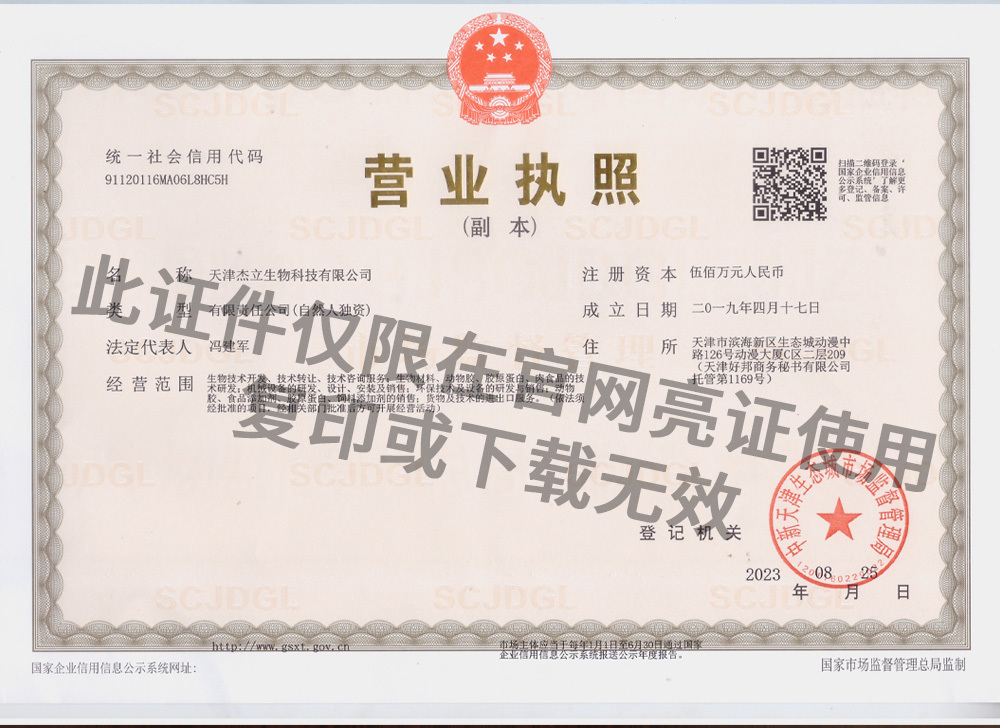
Tianjin Jieligel Biological Technology Co., Ltd | Powered by www.300.cn | Business license | SEO | Privacy Policy